There is a particular kind of exhaustion that belongs to the present moment. Not the exhaustion of work alone, but the fatigue of maintaining a life that is expected to be productive, social, desirable and culturally visible all at once. Katie Shannon’s Bedding inhabits this condition with remarkable precision.
The exhibition unfolds somewhere between the bedroom and the afterparty, between withdrawal and overstimulation. Rather than presenting intimacy as comfort, Shannon treats it as a site of ongoing negotiation. Beds appear throughout the space, but they refuse the reassuring symbolism traditionally attached to them. These are not places of rest. They feel temporary, compressed and improvised, as though sleep itself has become subject to logistical constraints.
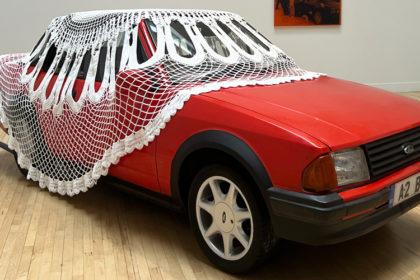
Exhibition view, Katie Shanno, Bedding, Tina gallery, London, 2026
What makes the work compelling is its refusal to romanticise either collapse or escape. The culture of nightlife, performance and social gathering hovers around the exhibition like a ghost. It is present not as liberation but as another rhythm within the same system. A cycle of acceleration followed by depletion. The bedroom and the dancefloor begin to resemble one another more than they differ.
Much of Shannon’s practice has long been concerned with translation. The movement of energy from one form into another. Here, events become images, encounters become drawings, and fleeting social experiences settle into material traces. The works carry the feeling of something remembered imperfectly, like posters left too long in a window or conversations reconstructed the morning after.
Exhibition view, Katie Shanno, Bedding, Tina gallery, London, 2026
Exhibition view, Katie Shanno, Bedding, Tina gallery, London, 2026
A recurring tension runs through the exhibition between aspiration and material reality. References to style, subculture and self fashioning are repeatedly undermined by physical conditions that feel stubbornly ordinary. Cramped rooms, worn surfaces, shared spaces and deferred ambitions. The work understands that contemporary identity is often assembled through fragments of cultural memory while being lived through increasingly precarious circumstances.
Humour plays an important role. Shannon avoids the solemnity that often accompanies discussions of economic pressure or emotional fatigue. Instead, absurdity emerges as a survival strategy. The exhibition recognises that contemporary life can feel simultaneously tragic and ridiculous, and that these two states frequently occupy the same room.
What ultimately lingers is a sense of suspension. Bedding is less interested in dramatic transformation than in the uncomfortable duration of things. Relationships that persist without resolution, desires that refuse to disappear, and bodies that continue despite exhaustion. Shannon captures a generation caught between the promise of freedom and the reality of limitation, finding within that contradiction not despair but an uneasy, stubborn vitality.
Exhibition view, Katie Shanno, Bedding, Tina gallery, London, 2026
Exhibition view, Katie Shanno, Bedding, Tina gallery, London, 2026
We use cookies to ensure that we give you the best experience on our website. If you continue to use this site we will assume that you are happy with it.